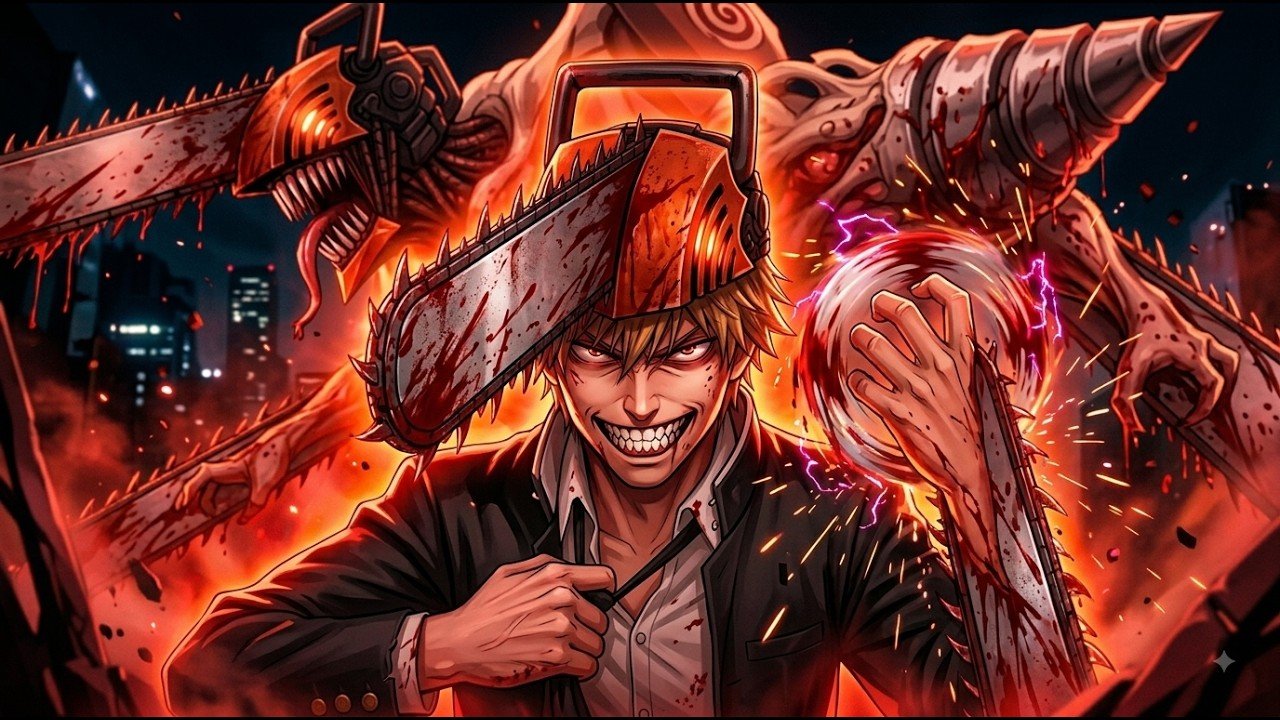
You finished Chainsaw Man. Good. Now here are twelve anime that hit the same raw nerve.
DOROHEDORO
Dorohedoro is the kind of show that throws you into a broken world with zero apology and expects you to keep up.
Dorohedoro follows a man with a reptile head who cannot remember who he is, hunting sorcerers through a city that looks like it was built inside a nightmare. The visual language is grotesque and funny and violent in the same breath, the same tonal cocktail that makes Chainsaw Man feel alive rather than edgy.
Midway through, the show starts peeling back the logic of its world, and you realize the chaos was never random, it was architecture. The comedy and the horror become impossible to separate, and that is exactly when it stops being something you watch and becomes something that sits with you.
It is for people who want anime that treats ugliness like a texture, not a warning label. Dorohedoro is on Netflix since twenty twenty.
DEVILMAN CRYBABY
Devilman Crybaby opens with kindness and ends with something that cannot be described without ruining it.
Devilman Crybaby takes the oldest story in demon mythology, humans fusing with monsters, and runs it through a modern lens that is stylish, sexually charged, and philosophically brutal. The aesthetic is fluid and ugly in the best way, and the pacing feels reckless until you understand it was always intentional.
Around the midpoint, the show shifts tonal register completely. What felt like a dark action series reveals itself as a tragedy about love and idealism colliding with a world that cannot hold either. The final arc delivers one of the most devastating sequences in the medium, and it earns every second of it.
It is for viewers who want something that punches through the screen and leaves a mark. Devilman Crybaby is on Netflix since twenty eighteen.
That one was designed to break you. The next one is designed to make you feel like you cannot trust anything you are watching.
PARANOIA AGENT
Paranoia Agent is a show that starts as a mystery about a boy with a golden bat attacking strangers and slowly becomes a dissection of modern psychological collapse.
Paranoia Agent was directed by Satoshi Kon, the same mind behind Perfect Blue, and it carries his signature ability to make the line between reality and delusion physically uncomfortable to look for. Each episode follows a different character being hunted by Shounen Bat, and each episode feels like a genre unto itself.
Midway through, the anthology structure starts collapsing inward, and you realize every disconnected story was actually one story about the same wound. The show is not interested in horror as sensation. It is interested in horror as diagnosis, and the patient is contemporary society.
It is for people who want anime that treats the audience like an adult with a psychology, not a consumer with a genre preference. Paranoia Agent is on Crunchyroll since two thousand and four.
VINLAND SAGA
Vinland Saga starts as a revenge story and then, at its cruelest moment, dismantles the entire idea that revenge was ever the point.
Vinland Saga follows Thorfinn, a boy who watches his father die and dedicates his life to killing the man responsible. The first arc is brutal, kinetic, and technically brilliant. Then the second arc begins, and the show asks whether a person built around violence can survive becoming something else.
In the final arc of the first season, the show strips everything away, and what is left is not a warrior, it is a hollow outline of one. That moment recontextualizes every single fight before it, and you feel the weight of all of it simultaneously.
It is for viewers who want the bloodshed of Chainsaw Man but with a philosophical architecture underneath. Vinland Saga is on Crunchyroll and Amazon Prime since twenty nineteen.
Wait. Before the next one, understand that what is coming is not just violent anime. It is one of the most structurally precise deconstructions of heroism ever made.
PUELLA MAGI MADOKA MAGICA
Puella Magi Madoka Magica opens looking like a magical girl show for children and spends twelve episodes systematically destroying what that genre promised you.
Puella Magi Madoka Magica treats its magical contract as a trap, its heroines as sacrificial systems, and its villain as the only honest voice in the room. The color palette is deliberately pastel. The violence, when it arrives, lands harder because of it.
Around episode three, the show makes a single narrative decision that permanently recalibrates your expectations. From that point forward every moment of apparent warmth feels like standing next to a lit fuse. The emotional devastation in the final arc is not spectacle. It is earned through meticulous construction over every episode before it.
It is for people who want Chainsaw Man’s willingness to hurt its characters in service of something true. Puella Magi Madoka Magica is on Crunchyroll since twenty eleven.
DEADMAN WONDERLAND
Deadman Wonderland drops you into a prison where inmates fight with their own blood and the system is the monster, no metaphor required.
Deadman Wonderland follows Ganta, a boy wrongfully convicted of massacring his classmates and thrown into a privatized death-prison where spectacle and suffering are entertainment. The premise is high-concept grotesque, the character dynamics are raw, and the villain is a direct line to the same unhinged energy that makes Chainsaw Man’s antagonists so memorable.
Midway through, the prison’s hidden layer opens up and the show shifts from survival thriller to something more conspiratorial and personal. The rage underneath the action is the engine, and it never lets you forget that the cruelty being depicted is systemic, not incidental.
It is for viewers who want their anime bleak, fast-moving, and genuinely angry about something. Deadman Wonderland is on Crunchyroll since twenty eleven.
INUYASHIKI
Inuyashiki asks what it means to have infinite power and gives that question to the two worst possible people to answer it.
Inuyashiki follows two men transformed into mechanical weapons after an alien incident, an elderly man everyone ignores and a teenager with nothing left to feel. One becomes a healer. One becomes a god who is bored. The contrast is not subtle, and that is precisely why it works.
Around the midpoint, the teenager’s arc stops being understandable and becomes genuinely disturbing, not because of the violence but because of how recognizable the psychology underneath it is. The show has the emotional DNA of Chainsaw Man in its willingness to make you care about someone whose worldview should repel you.
It is for people who want moral chaos with actual consequence. Inuyashiki is on Amazon Prime since twenty seventeen.
That was uncomfortable in the right way. Here is one that weaponizes atmosphere so precisely you will feel it before you understand it.
SHIGURUI: DEATH FRENZY
Shigurui: Death Frenzy is a samurai anime that has no interest in honor, legacy, or nobility, only in what violence actually costs a human body and mind.
Shigurui: Death Frenzy follows two crippled swordsmen about to fight to the death and unfolds their history through a structure so cold and deliberate it feels more like an autopsy than a narrative. The show is almost wordless in stretches, using composition and silence the way other anime use dialogue.
In the final arc, the full weight of every broken relationship and every absorbed wound lands at once, and the fight that opens the series finally makes sense, not as spectacle but as an inevitability that has been building across centuries of a single school’s ideology. Nothing is glorified. Everything is consequence.
It is for viewers who want artistic extremity paired with genuine formal discipline. Shigurui: Death Frenzy is on Crunchyroll since two thousand and seven.
Stay with this. Item eleven is the one most people sleep on, and it is the closest thing to Chainsaw Man’s emotional frequency that exists in the medium.
BLOOD-C
Blood-C starts as a slice-of-life school show about a girl who hunts monsters at night and then, in its second half, becomes something almost unwatchable in the best possible sense.
Blood-C follows Saya, cheerful and clumsy by day, lethal with a sword at night, and it spends its first half lulling you into a rhythm that it is about to detonate. The tonal whiplash when it arrives is not shock for its own sake. It is a structural argument about the relationship between comfort and complicity.
Midway through, a single episode dissolves all safety the show had constructed, and from that moment the logic of every scene before it inverts. The carnage in the back half is not gratuitous. It is the show completing a promise it made in its very first scene without your knowing. The ending is a genuine gut punch that reframes everything.
It is for people who want Chainsaw Man’s willingness to destroy its own premise in service of a larger emotional truth. Blood-C is on Crunchyroll since twenty eleven.
FROM THE NEW WORLD
From the New World is the slowest burn on this list and the one that will sit in your chest the longest after it ends.
From the New World follows five children in a seemingly peaceful future society where psychic powers are normal and the history of how that world was built is buried so deep no one is allowed to ask about it. The show moves deliberately, almost gently, for episodes at a time.
Around the midpoint, the full shape of the society’s architecture becomes visible, and the horror is not in what the monsters do. It is in what the humans decided was necessary. The final arc delivers revelations that transform every small moment from the early episodes into evidence of something enormous and terrible.
It is for viewers who want Chainsaw Man’s nihilism about institutional power but with a slow-release mechanism. From the New World is on Crunchyroll since twenty twelve.
Two left. And both of them hit different pressure points than anything else on this list.
HELL’S PARADISE
Hell’s Paradise is the closest thing to Chainsaw Man’s specific emotional architecture that aired in recent memory, and most people watched it casually when they should have been paying attention.
Hell’s Paradise follows Gabimaru, a ninja who cannot die and no longer wants to, sent to a paradise island with condemned criminals to retrieve an elixir for the Shogun. The setup sounds genre-conventional. The execution is not. The island is a biological horror made of Buddhist and Taoist mythology and the violence is inventive and purposeful in exactly the way Chainsaw Man’s is.
Midway through, the show pivots from survival action into something more philosophically dense, asking what it means to want to live when you have been built not to. The relationship dynamics, particularly Gabimaru and his executioner Sagiri, carry the same emotional charge as Denji and Makima, a dependency that you cannot stop watching even knowing it will cost someone.
It is for people who want Chainsaw Man’s exact blend of spectacle and genuine emotional devastation. Hell’s Paradise is on Crunchyroll since twenty twenty-three.
FIRE PUNCH
Fire Punch is not an anime. It is the manga Chainsaw Man’s author wrote before Chainsaw Man, and it is the rawest, most unfiltered version of Fujimoto’s instincts before any editorial polish reached them.
Fire Punch follows Agni, a boy in a frozen post-apocalyptic world who is set on fire and cannot die, burning forever because his regenerative power will not let him stop. The premise is so extreme it should be unreadable. Instead it becomes a meditation on suffering, narrative, performance, and whether a story that knows it is a story has any obligation to be kind to its characters.
Around the midpoint, the book introduces a filmmaker who begins using Agni’s burning body as the centerpiece of a film within the story, and the meta-layer that opens up is genuinely disorienting in the way only Fujimoto knows how to do. If you want to understand why Chainsaw Man works the way it does, this is the source code.
It is for readers who want to go all the way to the origin. Fire Punch is available on Manga Plus since twenty sixteen.
Those twelve are the ones worth your time. But the one I want to leave you with, the pick most people overlook entirely, is Shigurui: Death Frenzy. Not because it is the most entertaining. Because it is the most honest about what violence actually is, which is the question Chainsaw Man is always asking underneath all the blood. If you have been treating it as background noise, go back and pay attention.
Coming up next on Beyond Narrative, we are going into one of the most overrated genres in anime and pulling out the five titles that actually deserve the reputation everyone else in the genre is stealing. That one is coming soon, and it is going to start some arguments.
Related Collectibles
- Chainsaw Man — collectibles & merch
- Dorohedoro — collectibles & merch
- Devilman Crybaby — collectibles & merch
- Paranoia Agent — collectibles & merch
- Vinland Saga — collectibles & merch
- Puella Magi Madoka Magica — collectibles & merch
- Deadman Wonderland — collectibles & merch
- Inuyashiki — collectibles & merch
- Shigurui: Death Frenzy — collectibles & merch
- Blood-C — collectibles & merch
- From the New World — collectibles & merch
- Hell’s Paradise — collectibles & merch
- Fire Punch — collectibles & merch
About the Author