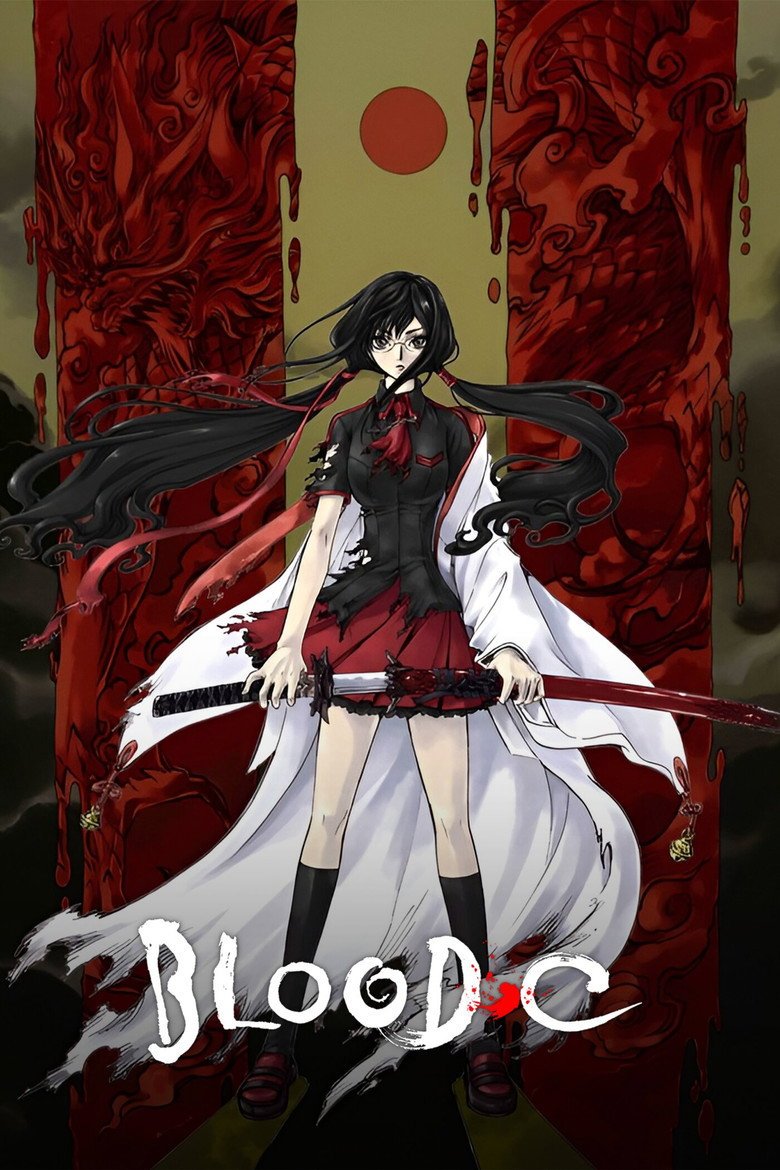
BLOOD-C
Blood-C starts as a slice-of-life school show about a girl who hunts monsters at night and then, in its second half, becomes something almost unwatchable in the best possible sense.
Blood-C follows Saya, cheerful and clumsy by day, lethal with a sword at night, and it spends its first half lulling you into a rhythm that it is about to detonate. The tonal whiplash when it arrives is not shock for its own sake. It is a structural argument about the relationship between comfort and complicity.
Midway through, a single episode dissolves all safety the show had constructed, and from that moment the logic of every scene before it inverts. The carnage in the back half is not gratuitous. It is the show completing a promise it made in its very first scene without your knowing. The ending is a genuine gut punch that reframes everything.
It is for people who want Chainsaw Man’s willingness to destroy its own premise in service of a larger emotional truth. Blood-C is on Crunchyroll since twenty eleven.
FROM THE NEW WORLD
From the New World is the slowest burn on this list and the one that will sit in your chest the longest after it ends.
From the New World follows five children in a seemingly peaceful future society where psychic powers are normal and the history of how that world was built is buried so deep no one is allowed to ask about it. The show moves deliberately, almost gently, for episodes at a time.
Around the midpoint, the full shape of the society’s architecture becomes visible, and the horror is not in what the monsters do. It is in what the humans decided was necessary. The final arc delivers revelations that transform every small moment from the early episodes into evidence of something enormous and terrible.
It is for viewers who want Chainsaw Man’s nihilism about institutional power but with a slow-release mechanism. From the New World is on Crunchyroll since twenty twelve.
Two left. And both of them hit different pressure points than anything else on this list.
HELL’S PARADISE
Hell’s Paradise is the closest thing to Chainsaw Man’s specific emotional architecture that aired in recent memory, and most people watched it casually when they should have been paying attention.
Hell’s Paradise follows Gabimaru, a ninja who cannot die and no longer wants to, sent to a paradise island with condemned criminals to retrieve an elixir for the Shogun. The setup sounds genre-conventional. The execution is not. The island is a biological horror made of Buddhist and Taoist mythology and the violence is inventive and purposeful in exactly the way Chainsaw Man’s is.
Midway through, the show pivots from survival action into something more philosophically dense, asking what it means to want to live when you have been built not to. The relationship dynamics, particularly Gabimaru and his executioner Sagiri, carry the same emotional charge as Denji and Makima, a dependency that you cannot stop watching even knowing it will cost someone.
It is for people who want Chainsaw Man’s exact blend of spectacle and genuine emotional devastation. Hell’s Paradise is on Crunchyroll since twenty twenty-three.
FIRE PUNCH
Fire Punch is not an anime. It is the manga Chainsaw Man’s author wrote before Chainsaw Man, and it is the rawest, most unfiltered version of Fujimoto’s instincts before any editorial polish reached them.
Fire Punch follows Agni, a boy in a frozen post-apocalyptic world who is set on fire and cannot die, burning forever because his regenerative power will not let him stop. The premise is so extreme it should be unreadable. Instead it becomes a meditation on suffering, narrative, performance, and whether a story that knows it is a story has any obligation to be kind to its characters.
Around the midpoint, the book introduces a filmmaker who begins using Agni’s burning body as the centerpiece of a film within the story, and the meta-layer that opens up is genuinely disorienting in the way only Fujimoto knows how to do. If you want to understand why Chainsaw Man works the way it does, this is the source code.
It is for readers who want to go all the way to the origin. Fire Punch is available on Manga Plus since twenty sixteen.
Related Collectibles
- Blood-C — collectibles & merch
- From the New World — collectibles & merch
- Hell’s Paradise — collectibles & merch
- Fire Punch — collectibles & merch
See the full list in the original video
About the Author